Monday, March 31, 2008

Vanna & the Vanalikes

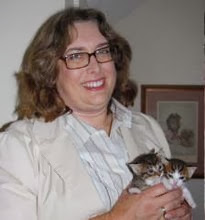
Vanna is the most recent foster cat in my home. She showed up as a stray in the garage of a family over the winter. They fed her, but couldn't keep her because the landlord wouldn't allow it. When they were quite sure she was pregnant, they found out the landlord was selling their building and they would have to move. They began looking for someone to take in the cat.

I picked her up two weeks ago and decided to name her Vanna because she was so very beautiful and because she looks like a Turkish Van breed of cat -- medium length fur, mostly white with color on her tale and head. She also has beautiful blue eyes.

The vet checked her out and she was healthy except for a bad case of ear mites. One week after I got her, she had the kittens on the Saturday morning before Easter. She had three kittens and all three look just like her! In my research on the Turkish Van, I discovered that domestic cats that look like the breed are known as "vanalikes" -- I loved that word and I decided it was a perfect description of these kittens.*

I wanted to give them Easter-related names, so the girls are Bunny (she has a cottontail spot of gray just above her tail) and Bonnet (she has the most gray on her head, sliding down over one eye) and the boy is Beau, which isn't Eastery, but it seems to fit. The spots on his head are the smallest and furthest apart.

Vanna is a wonderful mother and the kittens eyes started to open on their one-week birthday this past weekend.

*The Turkish Van is a rare, naturally occurring breed of cat from the Lake Van region of present-day Turkey. For Turkish Vans, the word van refers to their color pattern, where the color is restricted to the head and the tail, and the rest of the cat is white. It is the maximum expression of the piebald white spotting gene that makes the van pattern.[1] The spotting gene (Leucism) appears in many different species (like the horse and ball python). It also shows up in the common house cat, so a cat that shows this color pattern but is not registered or from the Van region, is called a "Vanalike".

Thursday, March 27, 2008

Can't we just stop killing baby seals?

I got this note today:

Tragically, starting today, off the eastern coast of Canada, the annual slaughter of baby harp seals will turn a pristine, white winter landscape that serves as a nursery into a bright red, bloody sea of carnage. That's right, 275,000 thousand baby seals, some just weeks old, will be bludgeoned with hakapiks (wooden clubs with sharp metal hooks at the tip) or shot! Even worse, some will be skinned alive, with their mothers close by, bellowing in fear, anger, and frustration.


During the past three years, the Canadian government sanctioned their fishermen to kill approximately 1,000,000 baby seals. We must do all we can to finally stop this!


WHAT WE CAN DO:


1) Click here https://community.hsus.org/campaign/trademinister_protectseals08?rk=zpzDI95qEX9zE to send a message to Canada's Minister of International Trade, David Emerson. Since the "hunt" is opposed by the overwhelming majority of people in Canada and around the world, Mr. Emerson must be convinced that the seal hunt damages Canada's economy and international reputation.


2) Click here https://community.hsus.org/campaign/US_2007_seal_resolution?rk=m1zDI9518A9lE to urge your two U.S. Senators to enact Resolution 118, which calls upon the Canadian government to end the brutal commercial seal hunt.


3) Click here http://www.hsus.org/protect_seals.html to sign the pledge to boycott Canadian seafood. Note: even if you don't actually eat Canadian seafood, I encourage you to sign it.


As always, thank you for speaking up for those who can't,

Wednesday, March 19, 2008

Safety First: Easter lilies are poisonous to cats

10 Common Household Products That Can Hurt or Kill a Child or Pet

Hollywood, FL 33021 March 18, 2008

“Don't take chances when it comes to your child or pet's safety (such as a dog, cat or ferret)," warns Debra Holtzman J.D, M.A, an internationally acclaimed safety and health expert and best-selling author of "The Safe Baby: A Do-It-Yourself Guide to Home Safety" (Sentient Publications).

"You can prevent injuries associated with these ten items by becoming educated about their potential danger and by taking the necessary precautions," says Holtzman.

1. Latex Balloons: More children have suffocated on uninflated balloons and pieces of balloons than any other type of toy. Balloon-related deaths are more common among children ages three and older than among younger children. Keep latex balloons away from children under 8 years old and pets. Consider mylar balloons instead.

2. Stuffed Toys: Be aware that seams can separate and allow stuffing or plastic pellets to be released, presenting a choking hazard. Check also for small detachable parts, security of eyes, nose and mouth of stuffed toys.

3. Garage Doors: Watch out for automatic garage doors. If your garage door does not already have one, install a sensor such as an "electric eye" for the garage door. It signals the door to reverse its motion if anything is in the way.

4. Disc Batteries: They may, if swallowed, stick in the throat or stomach, causing serious burns as the chemical leaks out.

5. Window Treatments With Hanging Cords: Those manufactured before 2001 can pose a potential strangulation hazard. Replace them with today's safer, cordless products, especially in children's bedrooms and play areas. Parents wishing to retrofit rather than replace can order free retrofit kits from the Window Covering Safety Council's Web site, www.windowcoverings.org, or by calling (800) 506-4636.

6. Antifreeze: Children or pets could drink large amounts of this sweet-tasting liquid if it is left out in an open container or if spilled on your driveway. The main ingredient in many major antifreeze brands is ethylene glycol, which is extremely toxic. (Be aware, dogs are known to chew through containers to get at antifreeze.) Use antifreeze with propylene glycol, which is considerably less toxic, or use antifreeze that has a bittering agent added to make it taste unpleasant.

Windshield washer fluid is also extremely toxic. It can cause blindness soon after ingestion.

7. Large and Heavy Furniture and Appliances: Eight thousand to 10,000 victims are treated in emergency rooms annually for furniture tip-over injuries, and some of these injuries are fatal. Use angle braces or anchors to secure to wall.

8. Dieffenbachia and Philodendron: These two common household plants are frequently ingested and can cause very serious symptoms. These plants contain oxalates, small crystals that get released into the mouth when the plant is chewed, causing extreme pain and inflammation.

A popular flower garden plant is the beautiful oleander. Everything about this plant is toxic, including the water in which cut flowers are placed and any smoke that results from burning the plant. In fact, a single leaf or berry can kill.

9. Storage Chests: Suffocation deaths occur in such places when a child or pet crawl inside and cannot escape. The best choice is one without a lid or one with a lightweight, removable one. If a chest closes, make sure it has ventilation holes.

10. Metal Jewelry: Not only do they pose a choking hazard, lead has been found in inexpensive children’s jewelry. In addition, some costume jewelry designed for adults has also been found to contain lead.

Lastly, remember to keep up-to-date on recalled products by visiting www.cpsc.gov or www.recalls.gov. These are products that have been found to be unsafe, hazardous or defective. Check your entire home and at your child’s school, pre-school or day care to be sure they are not using any recalled toys or equipment.

Important Note: Mega Brands has recalled about 2.4 million Chinese-made toys including MagnaMan action figures and Magtastik junior pre-school toys because small magnets could fall out and kids could swallow or inhale them. If more than one magnet is swallowed, they could attract each other and cause a potentially fatal intestinal blockage or perforation.

Holtzman recommends that parents avoid buying toy sets with small magnets for children under age 6.

Debra Holtzman has a master's degree in Occupational Safety and Health (OSHA) and is an attorney. She been featured on NBC’s Today Show, MSNBC and Discovery Health Channel and was chosen a Reader's Digest Everyday Hero. "The Safe Baby: A Do-it-Yourself Guide to Home Safety" (Sentient Publications) offers parents economical, easy-to-implement solutions to provide a safe, healthy, and green living lifestyle for children, dogs and cats.

"The Safe Baby" includes important information on toy safety, food safety, pet safety, pesticides, household chemicals, dangerous recalls, preventing lead poisoning, and how to handle emergencies.

Interviews may be arranged via: E-mail: safebook@aol.com
http://thesafetyexpert.com

Tuesday, March 18, 2008

China

I love watching the Olympics, but I am starting to think seriously about boycotting the Olympics in China. I just can't ignore the human rights violations there and the continuing cruelty to animals as well.

My friend S showed me these photos on another blog called Texas Oasis of cats being rounded up and killed in China. Widespread paranoia about cats spreading disease is communicated to the people through the government. As S pointed out, do they remember what happens when the cats are gone and rodents are everywhere?? Read the whole story at in the Daily Mail or the Times Online (UK). The HSUS has written a position statement, but I wonder why a search turns up blog entries but no significant US newspaper coverage?

The killing of the six stray cats at the kindergarten - where staff at a Beijing cigarette factory leave their children - is the most striking illustration of the city-wide fear of cats. A teacher at the nursery said:
"We did it out of love for the children. We were worried the cats might harm them. These six cats had been hanging around the kindergarten looking for food."
"So three male teachers put out plates of tuna in cages for bait, trapped the cats and then beat them to death with sticks."
"We were very worried the children might try to stroke them and that the cats might scratch them or pass on diseases. We had to get rid of the cats and this was the only way to do it."

Christie Yang of the charity Animals Asia, which liaises with the Beijing animal welfare groups, said:
"We are seriously concerned."
"We understand that with the Olympic Games the Beijing government is eager to show the world the city in a good light."
"But capturing and dealing with cats in such an inhumane way will seriously tarnish the image of Beijing and the Games."


Tuesday, March 11, 2008

Jennie settles in

Jennie came to me with her one kitten Joker. They had been dropped off at the Feline Rescue shelter, but needed to come into foster care because Joker was too young to stay at the shelter.
Jennie was very beautiful and very shy. Joker was silly looking and not shy at all. He was the favorite of the little two-year-old girl living across the street. Joker quickly found a wonderful home, but Jennie was going to be much harder to place. Then a wonderful couple fell in love with her photo and story online. They came to my house to meet her and were not put off by her shyness. They took her home to their house with two elderly cat-loving dogs. These people have been so patient with Jennie and love her just the way she is. They are rewarded with all the progress she has made. Here is the latest update I received:
Most people just have a coffee pot or toaster on their counter, we have.......


Jennie and "her" pups.

The black and white springer, Maggie, was her favorite but, unfortunately, we had to have her put to sleep (at almost age 16) a short time ago. I think Jennie makes a good schnoot-warmer.


Jennie and our remaining springer, Mandy. Boy, do her whiskers show up in the pic!


NASCAR fans ? She was actually watching the car go around the track, her head was moving to follow the motion.


Wednesday, February 27, 2008

Time to stop eating meat?

I'm not currently a vegetarian, but it may be inevitable. The recent video released by the Humane Society of the United States showing downed cattle being tortured and forced into slaughter was really too much to bear.

I was interested to see the following AP article in the StarTribune newspaper for Minneapolis/St. Paul discussing an earlier push for more humane treatment of animals on their way to slaughter. I was even more interested to learn that one of the champions of the movement was Hubert H. Humphrey from Minnesota:

Fifty years ago, the hog slaughter film by Arthur P. Redman galvanized animal welfare advocates to pursue legislation. The film was shown at a congressional hearing in 1957 and Congress passed the landmark humane slaughter law the following year.

Speaking during debate on the day of the bill's passage, then-Sen. Hubert Humphrey, a Minnesota Democrat and future vice president, said: "We are morally compelled, here in this hour, to try to imagine — to try to feel in our own nerves — the totality of the suffering of 100 million tortured animals. The issue before us today is pain, agony and cruelty — and what a moral man must do about it in view of his own conscience."

Humphrey, perhaps best known for his championing of civil rights, also pushed humane slaughter legislation for years, first introducing a bill in 1955. Initially, he wanted to make humane slaughter mandatory, but wound up settling for a compromise that made it a condition of doing business with the federal government. In 1978, the year Humphrey died, Sen. Bob Dole, R-Kan., won passage of legislation making compliance mandatory, fulfilling Humphrey's original vision.

Read the whole article at: http://www.startribune.com/local/16028557.html

My father was a vegetarian. He never made a big deal about it and always said that meat made him sick as a child. His mother/my grandmother could confirm that one day he refused to eat the meat included with his dinner and rather than do so went to bed without dinner and that was that.

It is only quite recently that I have questioned the story about getting sick. He didn't eat beef, pork, chicken or fish. He could certainly have gotten sick after eating some kind of meat and I could understand (maybe) giving that up, but to give up all forms of meat, abruptly and permanently, as a child, is surprising.

He was no doubt subject to various forms of ridicule throughout his life. There weren't a lot of vegetarians in the 50s, 60s, 70s, etc. I suspect now that he may have had an experience that caused him to connect the animals that are the source of meat with the food on his plate. He was always very tenderhearted about animals and we regularly took in cast-off pets when I was growing up.

Whatever his reasons for giving up meat, they were personal and he did not ever suggest that others follow his lead, but I did grow up with a role model who was basically a meat and potatoes kind of guy without the meat. There wasn't a lot of variety in his food: potatoes, vegetables, soup, peanut-butter sandwiches, grilled cheese sandwiches, salads, fruit and dessert!

Anyway, I've never been a big meat eater and I'm going to try to drop beef first, then pork. We'll see how it goes. It's tough because I rarely cook, that may have to change.

I very much like this quote another rescuer uses on her e-mail:

Think occasionally of the suffering of which you spare yourself the sight.
Albert Schweitzer

Monday, February 25, 2008

Feral or stray?

It's hard to believe, but it was just a few years ago when I first heard of mass spay/neuters of feral cats. Oh, let's be honest, when I started this I stumbled over spay or neuter for female or male cats and I wasn't quite sure what feral meant either.

Actually that's still open for discussion. Are all cats living outdoors considered feral? Or are feral cats only the wild ones untouched by human hands? The second is my interpretation. I think you start with "stray" cats living outside, divided into feral and tame.

Anyway, it was my friend K who told me it was a dream of hers to participate in a mass spay/neuter project and I think she shared an article with me about one in California. She lives in a neighborhood with lots of stray cats living outdoors in the hot summers and long cold winters of Minnesota. She feeds them, but it's not a good life.

For such an event, a mobile veterinarian medical vehicle comes in to a central area. Volunteers trap dozens of stray cats. One-by-one the cats are brought in for the surgery. The neuter surgery for the males is relatively simple and the cats recover quickly. Spay surgery for the females is a significant surgery and they need more time to recover.

In a trap/neuter/release (TNR) situation, the cats have the tip of their left ear removed and the cats are returned to their home territory. The ear is tipped so the cat is not brought in for subsequent TNR projects. It also helps a cooperative animal control to identify which animals are part of a managed feral colony.

If two-thirds of a colony is spayed and neutered, you can start to make a difference in the growth, behavior and health of the colony. The goal is to monitor the colony spay and neuter all the cats in a colony. The cats are also given some basic medical care, and the problematic spraying, fighting and yowling should be greatly reduced.

K and I have participated in several of these projects now and one of the "problems" you encounter is that not all the cats are feral (i.e., wild since birth), often many of them are just stray animals -- abandoned or allowed to roam. They will be spayed or neutered along with the rest, but should they be released or should we try to find homes for them? It seems obvious that we should find homes for them, but with shelters running at capacity that isn't always possible


Another moral dilemma for animal rescuers. It is not work for the fainthearted. I wish all cats could be fat and happy siblings, together forever, like Layla & Luke.